- NEWS
-
-
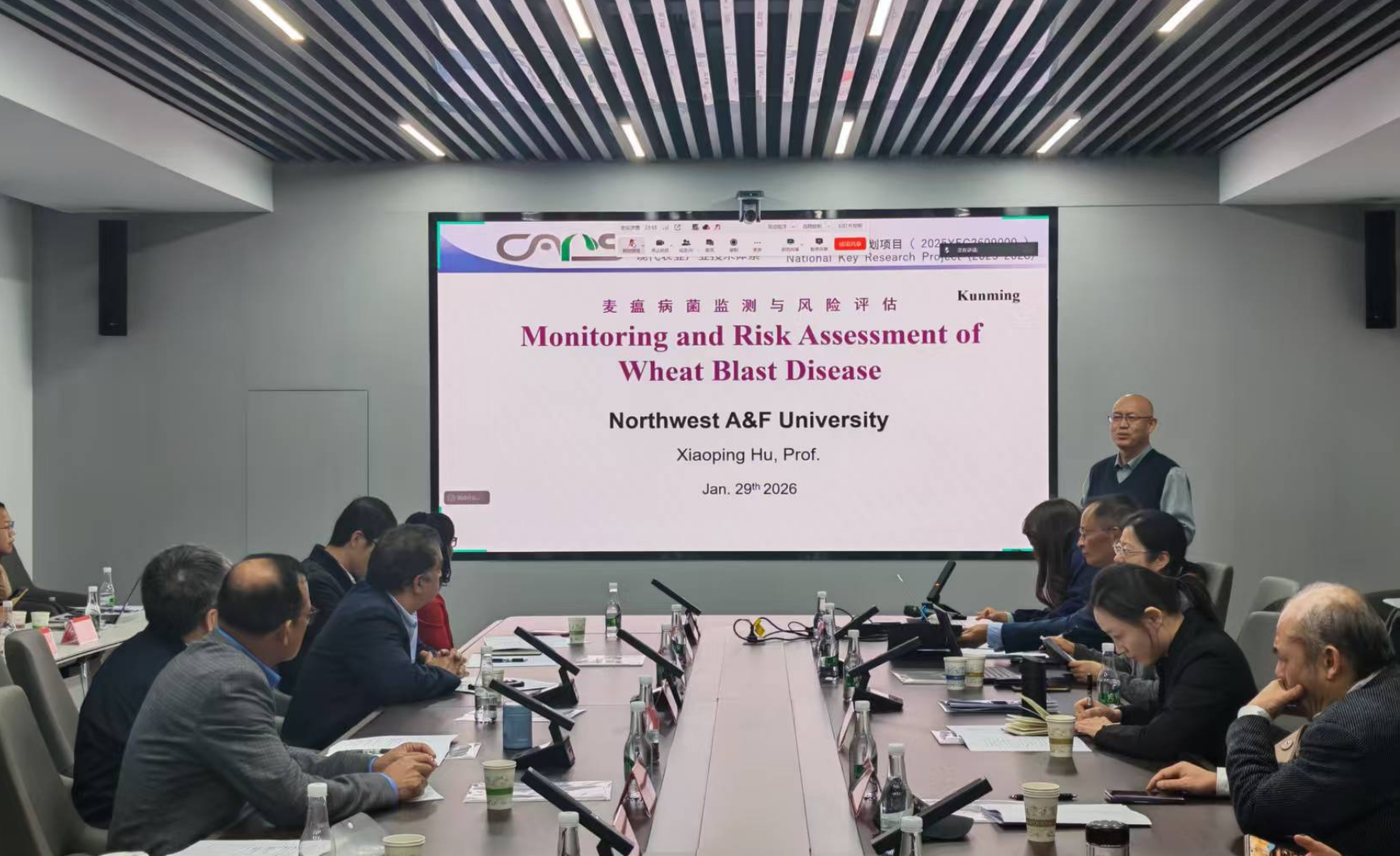
From January 28 to 31, 2026, the "Wheat Hazardous Disease Prevention and Control Symposium," co-hosted by Yunnan Agricultural University and the International Maize and Wheat Improvement Center (CIMMYT), was successfully held at the West Campus of Yunnan Agricultural University. The conference brought together top experts in the field of wheat disease prevention and control from both domestic and international institutions, conducting in-depth exchanges and discussions on topics such as the occurrence patterns, monitoring and early warning, integrated prevention and control, and biosafety management of wheat hazardous diseases.
Professor Hu Xiaoping and Associate Professor Li Yuxiang from the College of Plant Protection, Northwest A&F University, were invited to attend the conference. During the symposium, Professor Hu Xiaoping delivered a plenary report titled "Monitoring and Risk Assessment of Wheat Blast Disease," systematically introducing the monitoring and early warning technology system and risk assessment methods for wheat blast. He showcased the team's latest research achievements in this field, which attracted widespread attention and sparked lively discussions among the attending experts.
The symposium specially invited Academician He Zhonghu from the Institute of Crop Sciences, Chinese Academy of Agricultural Sciences; Pawan Singh, Chief Scientist of the CIMMYT Wheat Disease Resistance Breeding Program; as well as representatives from the Institute of Plant Protection, Chinese Academy of Agricultural Sciences, China Agricultural University, Northwest A&F University, Jiangsu Academy of Agricultural Sciences, and experts from Bangladesh, Uruguay, Zambia, and other countries, totaling more than 30 participants. After thorough discussions, the attending experts jointly formulated an "Action Plan" to address future wheat hazardous diseases, providing scientific guidance and an operational framework for global wheat disease prevention and control.
After the symposium, Hu Xiaoping and Li Yuxiang visited the Honghe Prefecture Academy of Agricultural Sciences for academic exchanges. Professor Hu Xiaoping delivered a special report titled "Invasive Alien Species and National Security." Combining typical cases, he deeply analyzed the potential threats of invasive alien species to China's agricultural production, ecological security, and national security, emphasizing the importance of strengthening monitoring and early warning systems and joint prevention and control mechanisms. The team engaged in thorough discussions with researchers from the Honghe Prefecture Academy of Agricultural Sciences and conducted in-depth explorations regarding future cooperation directions.